
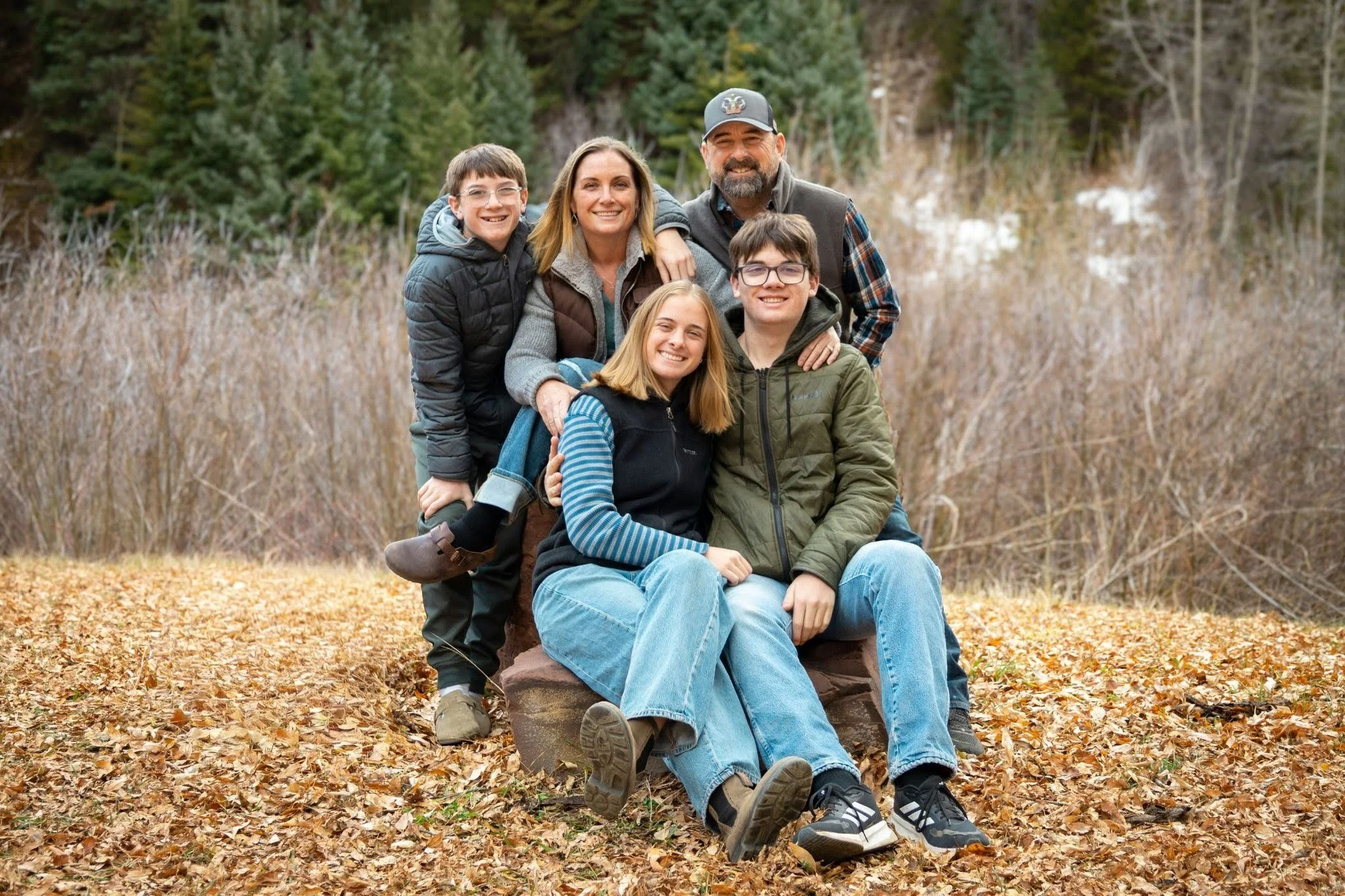
Tony with his wife, Danielle, and their three children Raelyn, Ethan, and Sam | Courtesy Photo
If you ask around Greater Yellowstone about how conservation gets done, nobody points to fluorescent lights over a desk buried in paperwork. Instead, they talk about miles logged on country roads, kitchen table conversations, and a quiet sense of responsibility to protect working lands and wild places for generations to come.
Few people embody that kitchen-table credibility quite like Tony Mong, the long-time regional lead for Wyoming Fish and Game. For years, Park County locals watched Wyoming Fish & Game reduce the hunting season year after year. So when Tony needed to shorten the mule deer hunting season to help a struggling herd recover, he gave people his word he'd bring those days back once conditions improved. Getting there meant working alongside local landowners, building the kind of trust that made the herd’s recovery possible. When the numbers turned around, Tony followed through on his word, proving to a skeptical community that his promise wasn’t just talk, and earning their trust for the long haul.
“I think that's all we have with one another, our word and our care for each other,” Tony reflects. “It really comes down to listening and doing what you say you're going to do.” That simple philosophy points to a larger truth across the West: private lands conservation moves at the speed of trust, built on personal integrity and genuine relationships.
Tony’s deep connection to the land started long before he wore a biologist's badge. Growing up in rural Missouri, hunting, fishing, and foraging were simply a way of life. Wild game was a daily staple rather than a weekend sport. That background gave Tony an unwavering sense of purpose in the field. He often refers to himself as a “wildlife biographer,” believing conservation is about doing right by the land and the animals that depend on it—a standard he refused to compromise on, even when standing his ground meant walking away from a career he loved.
That standard was put to the ultimate test when state officials pushed to build the Wyoming State Shooting Complex directly on critical habitat for mule deer and other species. Having spent most of his career studying these migrations, Tony knew the landscape was an irreplaceable refuge needed to survive the winter. Approving a high-impact development on a sanctuary this vital went against every value he stood for.
Tony faced a somber reality: fall in line to protect his position, or stand by the landscape and the community that trusted him. Choosing integrity over institution, Tony stepped down. He knew that once that trust was broken, he’d never get it back. Being able to look his neighbors in the eye mattered more than holding an agency title.
Stepping away from state service didn't end his work in the field, it gave him the freedom to practice conservation the way he always believed it should be done. For 16 years, bringing people together to tackle complex land issues was in his DNA, but agency structures treated community-building as a side task rather than a priority. LegacyWorks Group gave him an opportunity built around it instead: a place where conservation starts with relationships.
In a modern culture where promises are often made flippantly and words carry less weight than they used to, Tony relies on a simpler, old-school standard. “There's no secret recipe,” Tony says. “It's just being genuine, doing what you say you're going to do, and truly caring about people. That’s the biggest trust-gaining move I have.”
At LegacyWorks, Tony puts that hard-earned trust to work, bringing together landowners, agencies, and conservation partners so they can work together to tackle the region’s toughest challenges together.
“We can get a lot more done together than apart,” Tony reflects. “It’s like the saying goes: if you want to go fast, go by yourself. But if you want to go far, go together. That’s what I’ve been trying to lean into for years.”
Looking ahead, Tony envisions a Greater Yellowstone Ecosystem where trust is standard practice: collaborative conservation woven so deeply into the region that cross-sector partnerships are simply how business gets done.
“I hope that in five years, it isn't weird for landowners, NGOs, agencies, and hunting groups to sit in a room together and work out difficult problems,” Tony says. “I want that to be the norm—creating a situation that allows wildlife in this ecosystem to persist, and serving as a model that other places want to follow.”
His mission now is to spark curiosity, inspire wonder, and build those lasting, trust-based partnerships across every corner of the landscape.
Titles change, but true leadership remains constant. As Tony steps onto the working ranches of the Absaroka Front, he carries a truth proven over more than a decade and a half on the ground: lasting conservation isn't built in agency or nonprofit offices. It flourishes when integrity comes first, relationships lead, and people choose to move together at the speed of trust.