Capacity Building: The Engine of the Spiral Impact Model
Our Spiral Impact Model
Capacity building is not merely a supportive activity at LegacyWorks Group (LWG); it is the essential fuel for our Spiral Impact Model. LWG operates on the conviction that complex community challenges—such as climate change or systemic inequity—cannot be solved by single organizations working in isolation. Instead, transformative change requires an emergent, adaptive process where trust, skills, and networks are actively constructed alongside project deliverables.
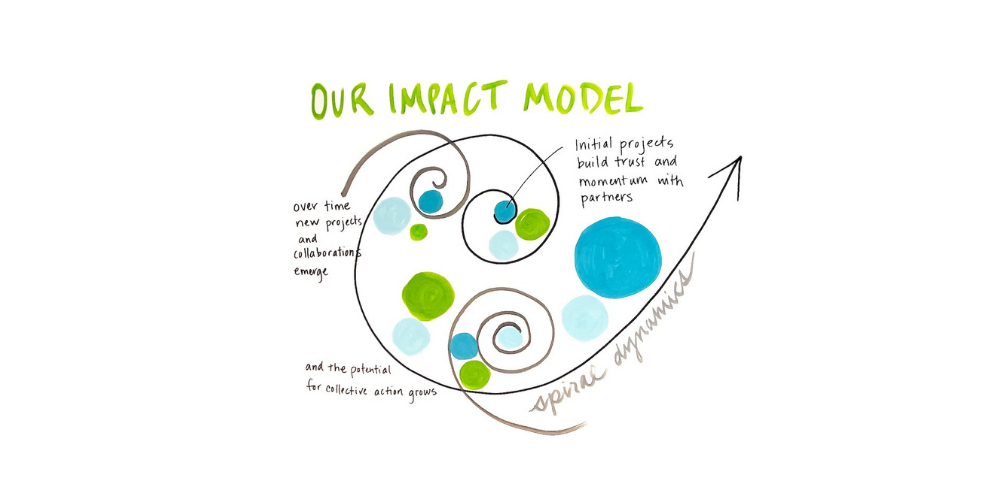
The Spiral Impact Model illustrates how capacity building transforms isolated efforts into systemic change through three distinct phases:
1. The Spark: Experiential Collaboration. The spiral begins not with a grand strategic plan, but with a specific, meaningful project that addresses an immediate community need. Unlike traditional projects that are contained within a single organization (represented as a static circle), LWG initiatives function as "crucibles". While delivering direct outcomes—such as acres restored or data collected—the primary purpose of these initial projects is to build the "connective tissue" of trust and relationship that makes future collaboration with stakeholders and other organizations in the community possible.
2. The Expansion: Trust as Momentum. As partners work together, the "indirect impacts" of the project—deepened relationships, shared achievement, and increased confidence—begin to surface new opportunities that were previously invisible. This creates a widening spiral: the trust generated in the first loop allows the collaborative to expand its circle, bringing in new partners and resources to tackle bigger projects and more complex challenges. This is why capacity building is Strategy 2 in our Theory of Change; without filling leadership gaps and enabling collaborative, facilitative leaders, the spiral cannot widen, and the initiative remains small and static.
3. The Transformation: Moving Towards Systemic Change. As the spiral widens, more and more collaborative projects get underway, and capacity to collaborate abounds in the community. We reach a cultural tipping point where whole-hearted collaboration becomes a community’s default approach to addressing its needs and priorities. By supporting the development of capacity and a broadening portfolio of collaboratives, the Spiral Impact Model enables smaller, localized efforts to combine into something of far greater strength and impact potential in a process akin to how hurricanes form from smaller storms and wind vortices in a process called cyclogenesis. The sum is greater than the parts, allowing communities to shift a stable but failing social, economic or ecological system (like a degrading ecosystem or inequitable economy) into a new, thriving state.
What we do matters, since each project needs to meet critical needs, align interests, and motivate participation and investment. But how we do the work matters even more. By focusing on doing the work in ways that build capacity and shift culture, we ensure that communities are not just solving today's problems, but are building the long-lasting ability and resilient infrastructure needed to navigate the unknown challenges of tomorrow.