
Weaving Landscapes: Pablo Castro Moreno and the Birth of Sierra a Mar
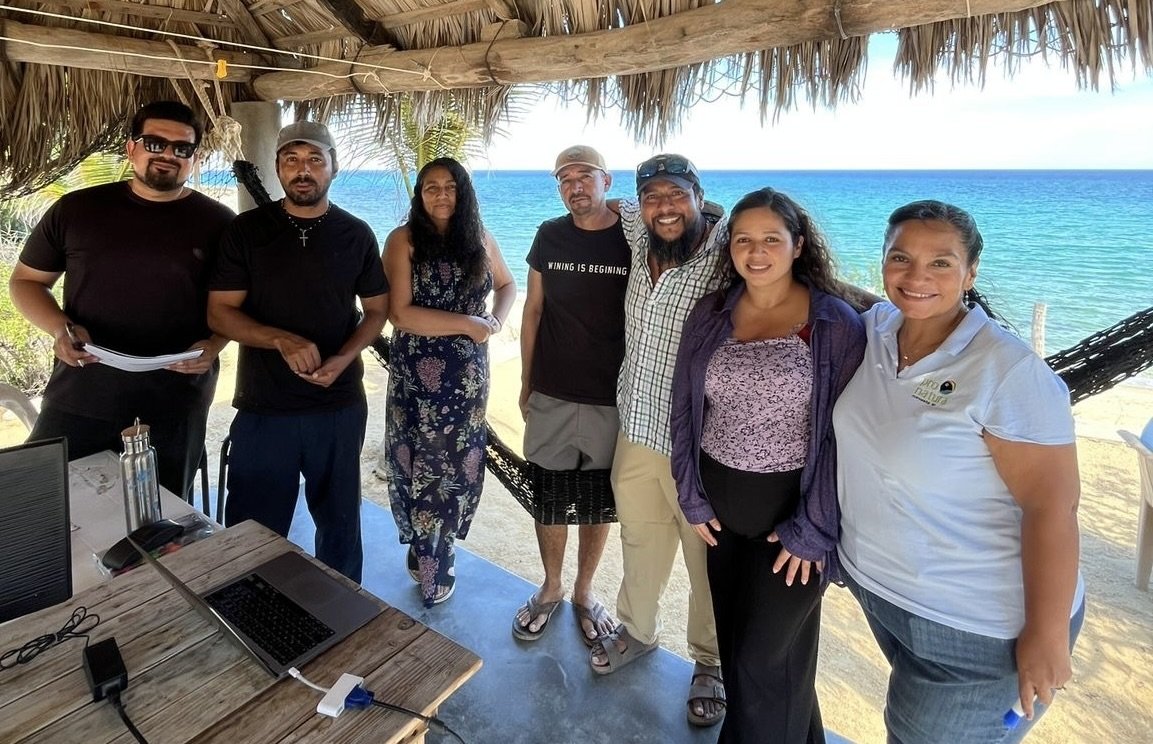
Pablo Castro Moreno (third from right) with community members in Boca del Álamo
When Pablo Castro Moreno first arrived in the dry, rolling mountains of the East Cape Region, he wasn’t looking for an impact model. He came “to understand what was happening in the landscape, but above all to listen.”
He spent entire mornings walking along streams that only run a few weeks each year. He joined fishermen at dawn to hear their stories about tides and shifting species. He sat in adobe kitchens in remote communities, where coffee is brewed in cloth filters and conversations soften.
In that mix of silence, wind, and local voices, Sierra a Mar began to take shape.
“One day I understood that it wasn’t a project — it was an interconnected landscape,” Pablo recalls. “The community talked about water, land, fishing, markets, family, and making a living from what they have traditionally done. Everything was connected. We only helped make those connections visible and show how working on each part was critical to the rest.”
What emerged from this patient work with the people who know their places from the roots up was Sierra a Mar, a regenerative community-driven, landscape-scale approach to impact in Baja California Sur, Guerrero, Jalisco, and Oaxaca. At the core of the model is capacity building. Sierra a Mar centers experiential learning and local leadership, ensuring that individuals, organizations, and the community as a whole strengthen the skills, confidence, and collaboration needed to prioritize their needs and steward their own collaborative processes. Every conversation, dawn fishing trip, and shared walk are part of a community-driven learning journey.
In 2019, when LegacyWorks México began collaborating in Boca del Álamo, Pablo identified patterns repeating across watersheds throughout the region: pressure on aquifers, degraded soils, dwindling fisheries, young people leaving the community, and a deep desire to recover a relationship with the land and sea.
“It was Pablo who helped us to connect those dots,” says Liliana Paredes Lozano. “He listens differently. He doesn’t come to impose. He comes to walk alongside you.”
One of the first signs that Sierra a Mar was taking form in Boca del Álamo was when different actors started working together with shared vision and values: fishermen from the area’s two cooperatives, regional and national conservation NGOs, local citizens and Mexico’s fisheries management authorities. It wasn’t a coincidence. Pablo had spent years “weaving,” as he likes to say—building the relationships and collective capacity needed for trust, coordination, and shared leadership to emerge organically.
“My work is to help processes appear, not invent them,” he explains. “When people feel that their place belongs to them — and that they have the ability to care for it — everything changes.”
That ability is the heart of capacity building: strengthening the knowledge, leadership, and alignment required for communities to guide their own future. Pablo opens up pathways to possibilities. This has translated into a 15,000-hectare marine management area now in final federal approval, overseen by a representative Management Committee that meets regularly and upholds rules the community negotiated and adopted together. Fishermen themselves helped define access, gear use, and conservation measures, while community-based monitoring systems are generating real-time data to guide decisions and ensure accountability. Leaders trained through the process are now supporting neighboring communities pursuing similar protections, extending the benefits beyond a single stretch of coastline.
“As human beings, we all have abilities that we don’t always recognize. Pablo helped me identify them and strengthen them,” says Andres Lucero, a local fisherman from Boca del Álamo. “Today I have tools that I can use with other people to convey messages and generate processes.”
The impact of Pablo’s work in Baja California Sur is rippling far beyond the region. The success of the community-led process in Boca del Álamo has inspired communities in Guerrero, Jalisco, and Oaxaca. Teams in each of those communities are now adopting and adapting Sierra a Mar to their own contexts because of its success in building capacity and getting real results. Each of those communities is now advancing regenerative economic development initiatives including marine reserves to support local fisheries, watershed restoration through agro-ecological systems, cooperatives creating economic opportunities for women, and regional platforms for inter-community dialogue.
Through shared learning exchanges, peer-to-peer mentoring, and community-driven initiatives, Sierra a Mar has become a platform for ongoing capacity building up and down the Pacific coast of Mexico. Meanwhile, Pablo continues doing what he does best: walking, listening, weaving connections, and holding space for solutions to emerge where they must — from the community members that steward their landscapes and will carry this work forward for generations.