
From Risk to Resilience: How North Carolina Food Hubs Are Strengthening Small Farms
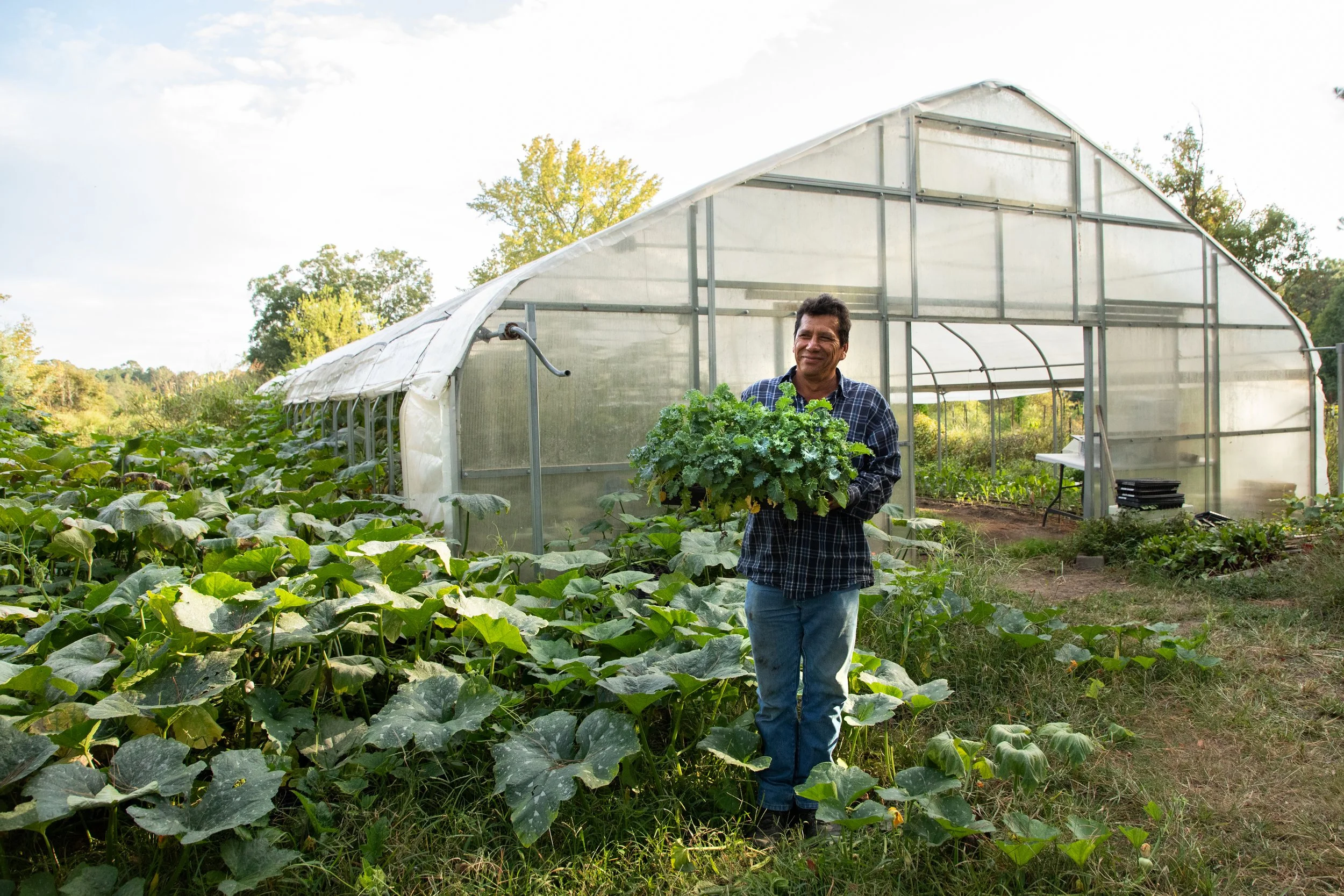
Mario Delgado of Mario Delgado Farm holds a fresh harvest of kale. Run alongside his farm partner Martha Mobley, the operation is one of many local farms partnering with Working Landscapes | Photo by Kim Hutchinson
The sun has not yet touched the soil in Oxford, North Carolina, but Elvin and Madeline Eaton of Fairport Farms are already awake, staring at a stack of seed catalogs by the glow of their kitchen light. To an outsider, this looks like the quiet start of a season. To a farmer, it is one of the most stressful moments of the year. Without a clear signal from the market, the Eatons are forced to make high-stakes decisions about what and how much to plant without knowing if they will find buyers on the other side of the summer.
The North Carolina Food Hub Collaborative was created to address this challenge. By aggregating and sharing market data across a network of regional food hubs, the Collaborative and its food hub members give farmers clearer signals about demand and help them make informed planting decisions. But the partnership extends beyond data sharing. It also helps bring in public funding to strengthen regional food system infrastructure and build partnerships across the network. This helps individual food hubs create stable market opportunities so farmers can grow their businesses with confidence and North Carolina communities can build stronger local food systems.
Before this effort, North Carolina’s food hubs largely operated independently. Food hubs help small-scale farmers sell to markets that they would be unable to access on their own. North Carolina’s food hubs help farmers tap into markets across a spectrum of channels from individual consumers to hospitals and schools. While each hub supported local farmers, there was little coordination or shared visibility into broader market trends. Recognizing both the potential and fragmentation of this system, Resourceful Communities helped connect and bring the hubs together.
Resourceful Communities has played a central role in formalizing this network since 2020. Acting as the backbone organization for ten established, independent food hubs, Resourceful Communities secures funding and provides capacity building support for the hubs to operate collectively at a statewide scale. This includes everything from building organizational capacity and funding technology upgrades to facilitating the shared data systems that allow the network to function more cohesively. Resourceful Communities' investment has enabled food hubs to be the primary engine activating local food initiatives across the state.
One of the first major steps in formalizing the Collaborative was the 2022 Matson Study, funded and facilitated by Resourceful Communities. The study quantified the multimillion-dollar economic impact of North Carolina’s food hubs, revealing a supply chain that had previously gone unrecognized at the state level. By demonstrating that these hubs were significant drivers of rural economic activity, the study helped secure $4 million in state funding for food hub infrastructure to expand the network’s capacity and strengthen connections between small farms and larger institutional buyers.
Beyond shared infrastructure, the Collaborative also works to reduce the financial risk farmers face when scaling production. Through a USDA Advancing Markets for Producers (AMP) grant, the Collaborative provides farmers funding to modernize operations, diversify crops, or expand into new markets. By helping cover upfront costs for equipment and certifications, the program allows farmers to make these shifts without putting their personal livelihoods at risk.
The impact of these investments is visible at Fairport Farms’ regional food hub partner, Working Landscapes. Based in Warrenton, Working Landscapes is one of the ten hubs in the Collaborative. As Director of Operations Jenni Rogan explains, “We have been able to respond to both consumer needs—by delivering larger orders in our new box truck, and farmer needs—by renovating the historic gin on our property to house a bean sheller.” These improvements have expanded both distribution capacity and market access for farmers.
As farmers expand production, timely market data becomes even more critical. Working Landscapes hosts annual farmer meetings and shares demand trends to help guide farmer decision-making. “They share valuable market information,” the Eatons explain. “This allows us to plan our planting schedule and reduces the risk of trying new crops at higher volumes.”
For the Eatons, this support has enabled tangible growth. “Based on market data and food hub access, we have scaled up and expanded production,” they note. “In the last year, we have purchased two additional high tunnels and a metal building for the farm.” With clearer demand signals and financial backing, investing in expansion becomes a calculated decision rather than a gamble.
In the year ahead, Resourceful Communities and its partners will build on this success by developing a team of Market Builders to help food hubs reliably connect more small farmers with more and more buyers, including larger institutions that can contract in advance and further reduce uncertainty for farmers. By enabling this kind of transformation for farmers like the Eatons through data access, shared infrastructure, financial support and dependable access to buyers, the Food Hub Collective and its ten member food hubs are building more resilient and sustainable local food systems - and a brighter future for rural communities across North Carolina.